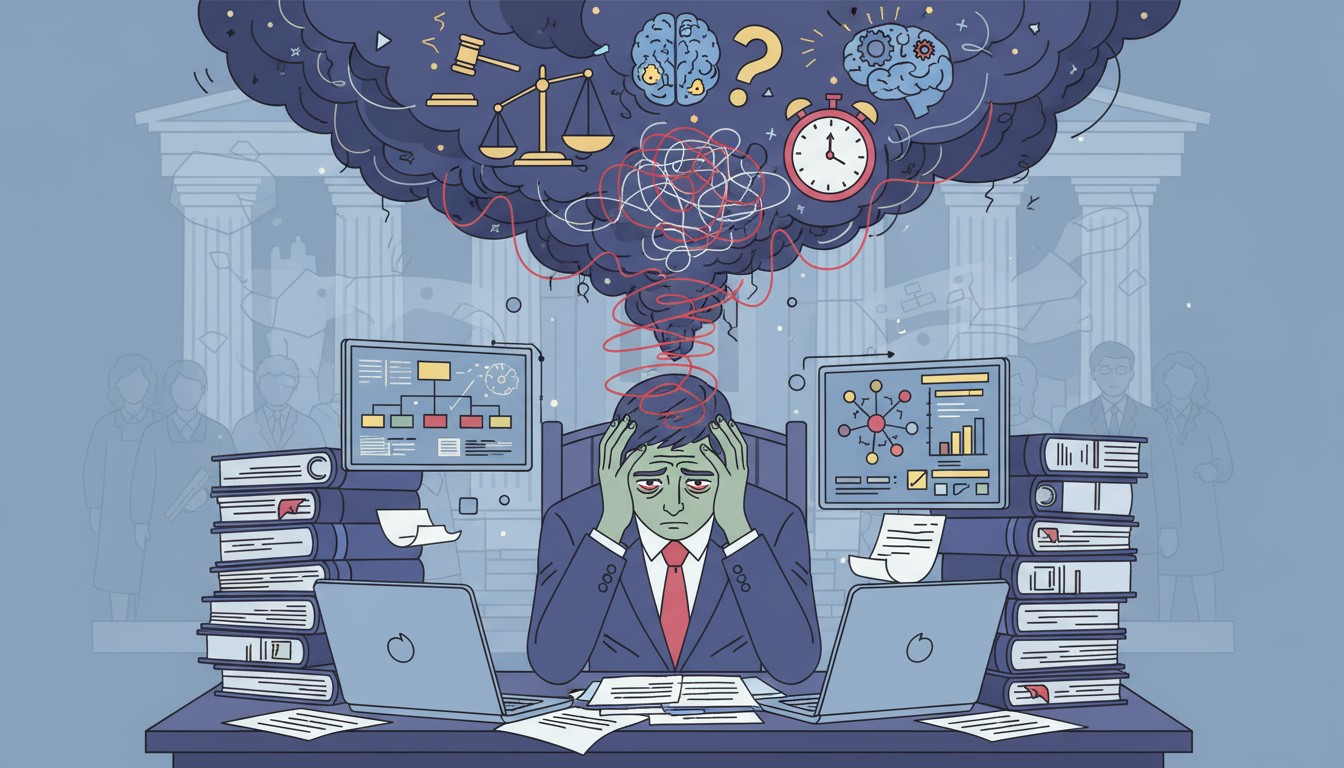
Decision fatigue represents a psychological phenomenon where making numerous choices gradually depletes mental energy, reducing the quality of subsequent decisions regardless of their importance or the individual’s motivation to choose wisely. Research demonstrates that humans possess limited cognitive resources for decision-making—each choice, whether trivial or significant, draws from the same mental reservoir until that reservoir becomes depleted, causing decision quality to deteriorate predictably as people make more choices throughout the day or across extended periods requiring sustained decision-making. This phenomenon affects everyone from judges handing down harsher sentences before lunch breaks to consumers making impulse purchases after exhausting mental energy on earlier shopping decisions, but it proves particularly devastating for legal plaintiffs who face months or years of continuous high-stakes choices about case strategy, settlement offers, medical treatments, financial priorities, and countless procedural matters while simultaneously managing the normal decisions required by work, family, and daily life.
The legal system’s failure to acknowledge decision fatigue creates substantial justice problems—as plaintiffs’ cognitive resources deplete throughout litigation, they make progressively worse decisions about settlement negotiations, witness testimony, evidence presentation, and strategic choices that significantly impact case outcomes, often accepting inadequate settlements or making poor procedural choices not because offers are actually fair or choices are strategically sound but because mental exhaustion makes continuing litigation feel impossible regardless of case strength or potential recovery amounts. Attorneys frequently misinterpret these patterns as clients losing interest in cases or becoming unreasonably difficult, failing to recognize that cognitive depletion rather than character flaws or strategic reconsideration drives clients’ changing behavior and decision-making capabilities throughout prolonged legal proceedings.
This comprehensive exploration examines the neuroscience and psychology behind decision fatigue, investigates how legal proceedings uniquely multiply decision-making demands beyond normal life requirements, analyzes the specific ways litigation depletes cognitive resources through stress, uncertainty, and repetitive choices, documents how decision fatigue affects case outcomes and settlement negotiations, addresses the physical manifestations of mental depletion during legal processes, and provides evidence-based strategies for managing cognitive resources throughout litigation. The analysis synthesizes research from organizations including American Psychological Association cognitive psychology research, neuroscience studies examining decision-making mechanisms, legal psychology examining litigation stress effects, and practical observations from attorneys and mental health professionals working with clients experiencing profound decision fatigue throughout civil litigation. Most critically, this article acknowledges that decision fatigue represents an invisible but powerful force undermining plaintiffs’ capacity to advocate effectively for their interests, creating systemic advantages for defendants and insurance companies who benefit from plaintiffs’ growing inability to sustain cognitively demanding litigation processes over months and years of proceedings that incrementally exhaust mental resources essential for sound judgment.
The Neuroscience of Mental Depletion: How Decisions Exhaust Your Brain
Neuroscience research reveals that decision-making activates the prefrontal cortex, the brain region responsible for executive functions including judgment, impulse control, planning, and rational analysis of options and consequences. Each decision requires the prefrontal cortex to evaluate alternatives, weigh competing priorities, predict outcomes, manage emotions influencing choices, and execute final selections—cognitively demanding processes consuming measurable metabolic resources including glucose that the brain requires for optimal functioning. Extended periods of decision-making without adequate rest deplete these resources, causing the prefrontal cortex to function less effectively and producing measurable changes in decision-making patterns including increased impulsivity, reduced consideration of long-term consequences, greater susceptibility to emotional reasoning over rational analysis, and tendency to either avoid decisions entirely or default to easiest options regardless of their appropriateness for the situation requiring choice.
Brain imaging studies demonstrate that decision fatigue manifests as reduced activity in prefrontal regions controlling rational deliberation combined with increased activation in emotional processing centers, essentially shifting decision-making from thoughtful analysis toward automatic responses driven by immediate feelings rather than careful consideration of relevant factors. This neurological shift explains why decision-fatigued individuals make choices they later regret—their brains literally function differently when cognitively depleted, prioritizing mental ease and emotional comfort over strategic thinking and long-term optimization. Research by psychologist Roy Baumeister documenting decision fatigue’s effects found that depleted decision-makers exhibit measurably worse performance on tasks requiring self-control, persist less when facing difficulties, and make choices favoring immediate gratification over delayed benefits—patterns profoundly problematic for legal plaintiffs who need sustained focus, strategic patience, and ability to resist pressure for premature settlements offering immediate relief but inadequate compensation.
The depletion affects not just decision quality but also emotional regulation and stress management—the same prefrontal cortex resources that support sound decision-making also enable emotional control, meaning that decision fatigue simultaneously impairs both cognitive judgment and emotional resilience. This creates vicious cycles where litigation stress depletes mental resources, reducing capacity for managing that stress effectively, which intensifies stress levels and further depletes cognitive reserves in self-reinforcing patterns that progressively worsen throughout extended legal proceedings. According to research published by National Institutes of Health neuroscientists, chronic decision fatigue produces measurable impacts on mental health including increased anxiety, depressive symptoms, sleep disturbances, and difficulty concentrating—symptoms commonly observed in litigation clients that attorneys often attribute to case stress without recognizing that cognitive depletion from sustained decision-making represents a distinct mechanism requiring specific intervention strategies beyond general stress management.
The Legal Multiplier Effect: Why Lawsuits Generate Endless Decisions
Legal proceedings generate exponentially more decisions than normal life, overwhelming plaintiffs with choices about attorney selection, case strategy, settlement negotiations, medical treatment options, witness cooperation, document production, deposition testimony, expert witness selection, trial preparation, and countless procedural matters that each require careful consideration with significant consequences for case outcomes and financial recovery. Unlike normal decision-making contexts where people can defer choices, delegate to others, or accept default options with minimal consequences, litigation forces plaintiffs to engage personally with high-stakes decisions that cannot be postponed or avoided without damaging cases that represent their primary means of recovering compensation for serious injuries affecting their health, finances, and quality of life indefinitely.
The decision load begins immediately and never stops—from the first attorney consultation requiring plaintiffs to evaluate legal representatives’ competence, communication styles, and fee structures, through initial case filings demanding choices about which parties to sue and what claims to assert, into discovery producing endless decisions about which documents to produce, how to answer interrogatories, what to reveal during depositions, whether to undergo independent medical examinations, and how much personal information to disclose to opposing counsel. Each of these decisions carries real consequences while requiring cognitive effort to evaluate options, predict outcomes, weigh competing considerations, and commit to courses of action despite uncertainty about whether choices will prove optimal as cases progress through unpredictable legal processes where initial decisions constrain future options in ways plaintiffs cannot fully anticipate when making earlier choices.
Settlement negotiations particularly multiply decision-making demands as plaintiffs receive offers requiring careful evaluation of monetary amounts against injury severity, future medical needs, lost earning capacity, litigation costs, emotional costs of continued proceedings, risk of worse outcomes at trial, and countless other factors that must be weighed simultaneously while insurance companies deliberately time offers to maximize pressure and minimize plaintiffs’ deliberation time. Research examining settlement dynamics reveals that defendants strategically exploit plaintiff decision fatigue by extending litigation to exhaust cognitive resources, then presenting settlement offers requiring immediate responses when plaintiffs feel least capable of careful analysis—tactics that prove remarkably effective at securing favorable settlements for defendants by capitalizing on plaintiffs’ depleted mental state rather than engaging with case merits or fair compensation calculations. According to analysis from legal psychology experts at Nolo, plaintiffs experiencing severe decision fatigue accept settlement offers averaging thirty to forty percent below what similarly situated but mentally fresh plaintiffs negotiate, representing substantial financial losses directly attributable to cognitive depletion rather than case weaknesses or reasonable strategic assessments.
The Stress Amplification Loop: How Litigation Anxiety Accelerates Mental Exhaustion
Chronic stress from litigation exponentially accelerates decision fatigue by consuming the same cognitive resources needed for sound decision-making—stress responses activate fight-or-flight systems that prioritize immediate survival over careful deliberation, diverting mental energy toward threat monitoring and emotional management rather than rational analysis of options and consequences. This means that stressed plaintiffs face double burden of both increased decision-making demands from litigation and reduced cognitive capacity for handling those demands due to stress depleting the exact mental resources that effective decision-making requires. The combination proves devastating as plaintiffs struggle with complex legal choices while simultaneously managing the anxiety, uncertainty, and emotional distress that litigation inevitably produces regardless of case strength or ultimate outcomes.
Sleep disruption from litigation stress further compounds decision fatigue—research consistently demonstrates that inadequate sleep severely impairs prefrontal cortex functioning and decision-making quality, with sleep-deprived individuals exhibiting decision-making patterns virtually identical to those experiencing cognitive depletion from excessive choices. Many litigation clients report chronic sleep problems from worrying about cases, reviewing legal documents and decisions during hours they should be sleeping, and experiencing anxiety-driven insomnia preventing the deep sleep necessary for cognitive restoration. This creates particularly vicious cycles where litigation stress disrupts sleep, sleep deprivation impairs decision-making, poor decisions create additional case complications and stress, and worsening stress further disrupts sleep in self-reinforcing patterns that progressively degrade plaintiffs’ cognitive functioning throughout extended proceedings requiring sustained mental clarity and strategic judgment.
The unpredictability of legal proceedings intensifies stress impacts on decision-making—humans cope better with stress when they can predict demands and prepare appropriately, but litigation involves constant uncertainty about timelines, outcomes, opposing party actions, and procedural requirements that emerge unpredictably throughout cases. This uncertainty prevents effective stress management because plaintiffs cannot anticipate when they will need maximum cognitive resources, instead maintaining constant elevated alertness that chronically depletes mental energy without providing recovery periods where decision-making demands temporarily decrease allowing cognitive restoration. Research examining chronic uncertainty’s psychological effects demonstrates measurable increases in cortisol and other stress hormones that directly impair prefrontal cortex functioning, essentially creating biological mechanisms through which litigation stress chemically inhibits the brain regions required for sound judgment about the very legal matters generating that stress initially.
Warning Signs of Severe Decision Fatigue During Litigation
Decision Avoidance: Constantly postponing choices about case matters, failing to respond to attorney communications requiring decisions, or asking lawyers to decide everything without plaintiff input despite matters requiring client direction
Impulsive Acceptance: Agreeing quickly to settlement offers, procedural decisions, or strategic changes without careful consideration, driven by desire to end decision-making burden rather than genuine assessment that choices serve interests
Cognitive Paralysis: Feeling mentally frozen when facing decisions, inability to evaluate options clearly, or experiencing physical symptoms like headaches and muscle tension when contemplating case choices
Everyday Impact: Finding routine daily decisions like meal planning, clothing selection, or minor purchases feel impossibly difficult, suggesting cognitive depletion extending beyond litigation into general life functioning
When Simple Choices Become Impossible: Daily Life Under Decision Overload
Decision fatigue from litigation extends far beyond case-related choices, degrading plaintiffs’ capacity for managing ordinary life decisions about work, family, finances, and personal matters that continue requiring attention despite litigation consuming cognitive resources. Plaintiffs report that activities once requiring minimal mental effort—choosing dinner menus, coordinating family schedules, making routine purchases, planning social activities—become surprisingly difficult as litigation depletes the mental energy previously available for these everyday decisions. The phenomenon proves particularly distressing because plaintiffs recognize intellectually that choices are trivial yet feel genuinely unable to make them, creating additional stress from awareness that their cognitive functioning has deteriorated in ways affecting basic competence for managing normal adult responsibilities.
Family members often notice cognitive changes before plaintiffs themselves recognize the pattern—spouses report that partners who previously made household decisions confidently now struggle with basic choices, ask repeatedly for input on minor matters, or become irritable when pressed to make decisions about issues requiring immediate resolution. Children may observe parents’ reduced patience, difficulty maintaining routines, or withdrawal from family activities requiring planning and coordination. These relational impacts compound plaintiffs’ stress as they worry about failing family responsibilities while feeling powerless to improve cognitive functioning without resolving litigation that may continue for months or years beyond plaintiffs’ control given procedural timelines, opposing party tactics, and court scheduling constraints.
Work performance frequently suffers as decision fatigue impairs professional functioning—employees facing litigation struggle with job responsibilities requiring judgment, problem-solving, strategic thinking, and sustained concentration, all cognitive functions degraded by decision depletion. Some plaintiffs report making uncharacteristic errors at work, avoiding complex projects, delegating excessively to avoid decision-making, or requesting leaves of absence when cognitive impairment becomes severe enough to threaten job performance and employment security. The financial consequences prove particularly devastating for plaintiffs whose injuries already reduced earning capacity and who now face additional income threats from litigation-induced cognitive impairment affecting workplace competence. According to research from Society for Human Resource Management workplace psychology researchers, employees experiencing chronic decision fatigue show productivity declines of twenty to thirty-five percent compared to baseline functioning, representing substantial economic losses that litigation costs plaintiffs beyond medical expenses and legal fees typically calculated when assessing case impacts.
The Settlement Trap: How Exhaustion Drives Inadequate Resolutions
Insurance companies and defense attorneys understand decision fatigue dynamics and deliberately structure litigation to maximize cognitive depletion, recognizing that exhausted plaintiffs accept lower settlements than mentally fresh ones would negotiate. Tactics include extending discovery unnecessarily to prolong decision-making demands, scheduling depositions and medical examinations at inconvenient times maximizing plaintiff stress, submitting voluminous document requests requiring sustained attention and organizational effort, raising frivolous procedural objections demanding plaintiff responses, and timing settlement offers to coincide with periods of maximum plaintiff stress when cognitive resources are most depleted and resistance to pressure feels impossible despite inadequate offer amounts.
The psychological mechanism proves remarkably effective—research demonstrates that decision-fatigued individuals dramatically increase their preference for ending decision-making situations even at substantial cost, essentially paying premiums to escape situations requiring continued choices regardless of whether those choices might produce better outcomes with sustained engagement. For litigation plaintiffs, this manifests as accepting settlement offers clearly below fair compensation simply because accepting ends the decision-making burden while rejecting offers means continuing months of additional choices about trial preparation, witness testimony, jury selection, and countless other matters that cognitively depleted plaintiffs feel genuinely unable to manage effectively. Attorneys frequently observe clients initially committed to pursuing full compensation gradually becoming willing to accept progressively lower offers as litigation continues, often misinterpreting this pattern as clients realizing their cases are weaker than initially believed rather than recognizing that cognitive depletion rather than case reassessment drives changing settlement preferences.
The timing of settlement offers strategically exploits decision fatigue patterns—research shows that cognitive depletion peaks during late afternoon and evening hours, yet defense counsel often structure settlement negotiations for late-day time slots when plaintiffs’ decision-making capacity is most compromised. Similarly, settlement demands frequently arrive after particularly stressful events like contentious depositions or difficult medical examinations when plaintiffs feel emotionally drained and cognitively exhausted from managing intense legal proceedings. These tactics succeed because decision-fatigued individuals genuinely cannot evaluate settlement adequacy accurately when mentally depleted, lacking cognitive resources to carefully analyze offer amounts against actual damages, future needs, litigation costs, and probability-weighted trial outcomes—calculations requiring the precise analytical capabilities that decision fatigue systematically impairs throughout extended legal proceedings designed partly to produce the exhaustion that makes plaintiffs vulnerable to inadequate settlement pressure.
Physical Manifestations: When Mental Exhaustion Becomes Bodily Symptoms
Decision fatigue produces measurable physical symptoms that plaintiffs and attorneys often fail to recognize as cognitive depletion manifestations rather than separate health problems—chronic headaches, muscle tension particularly in neck and shoulders, digestive problems, elevated blood pressure, weakened immune function, and generalized fatigue that persists despite adequate rest all represent common somatic expressions of sustained mental overload from decision-making demands. These physical symptoms compound cognitive impairment by creating additional discomfort distracting from focused decision-making, reducing energy available for careful deliberation, and generating new concerns about health problems that may feel unrelated to litigation stress despite directly resulting from cognitive depletion mechanisms.
Sleep architecture particularly suffers from decision fatigue—even when plaintiffs sleep adequate hours, decision overload degrades sleep quality by increasing nighttime awakenings, reducing deep sleep stages essential for cognitive restoration, and producing racing thoughts during sleep transitions as brains continue processing unresolved decisions preventing the mental disengagement necessary for restorative rest. Many litigation clients report vivid dreams about cases, waking repeatedly to worry about decisions, and feeling unrefreshed despite sleeping normal durations, patterns reflecting compromised sleep quality rather than inadequate sleep quantity. This creates particularly problematic cycles because poor sleep further impairs decision-making, increasing cognitive load when facing subsequent choices and accelerating the decision fatigue progression that disrupted sleep quality initially.
Appetite and eating patterns also reflect decision depletion—research demonstrates that cognitive fatigue reduces self-control around food, increases preference for convenient but unhealthy options, and impairs nutritional decision-making as depleted individuals default to immediately satisfying choices over health-optimizing ones. Litigation plaintiffs frequently report weight changes, increased consumption of comfort foods high in sugar and fat, skipped meals due to decision paralysis about meal planning, or eating irregularly as cognitive resources required for maintaining healthy dietary patterns become consumed by litigation demands. These nutritional impacts create additional health consequences while further depleting energy and cognitive function through poor nutrition, essentially compounding decision fatigue through biological mechanisms linking mental depletion to dietary choices that worsen cognitive impairment through inadequate nutritional support for brain function. According to research from Harvard Medical School stress researchers, chronic stress combined with decision fatigue produces measurable inflammatory responses, hormonal disruptions, and metabolic changes that increase risks for cardiovascular disease, diabetes, and other serious health conditions—meaning that litigation’s cognitive burden literally threatens plaintiffs’ physical health through biological mechanisms linking mental exhaustion to systemic physiological deterioration.
Evidence-Based Strategies for Protecting Cognitive Resources
Decision Batching: Consolidate litigation decisions into scheduled blocks rather than addressing them continuously, allowing cognitive recovery between decision sessions and preventing constant depletion from ongoing choices throughout days and weeks
Morning Priority: Handle important case decisions during morning hours when cognitive resources are freshest, avoiding late-day settlement negotiations or strategic discussions when mental fatigue peaks predictably
Routine Automation: Reduce daily life decisions through routines, meal planning, wardrobe simplification, and delegation, preserving cognitive resources for litigation matters requiring careful attention
Attorney Collaboration: Work with lawyers to identify which decisions genuinely require plaintiff input versus those attorneys can handle independently, reducing unnecessary decision-making demands without compromising case control
Cognitive Restoration: Recovering Mental Clarity During Ongoing Litigation
Combating decision fatigue during litigation requires proactive cognitive restoration strategies that actively rebuild mental resources rather than simply managing depletion—research demonstrates that specific activities effectively restore decision-making capacity including physical exercise, time in nature, meditation and mindfulness practices, engaging hobbies requiring focus but minimal decision-making, and adequate sleep in environments promoting deep rest. Exercise particularly provides powerful restoration benefits by increasing blood flow to prefrontal regions, stimulating neuroplasticity supporting cognitive function, reducing stress hormones impairing judgment, and providing mental breaks from litigation concerns that allow cognitive systems to recover from sustained decision-making demands. Even moderate physical activity like brisk walking produces measurable improvements in subsequent decision-making quality compared to sedentary rest periods that provide minimal cognitive restoration despite feeling relaxing.
Nature exposure offers unique restoration qualities that other environments cannot replicate—research examining attention restoration theory demonstrates that natural settings automatically capture attention in ways that restore directed attention capacities without requiring cognitive effort, essentially allowing mental systems governing decision-making to recover while individuals remain engaged with environments rather than resting passively. Studies show that even brief nature exposure like twenty-minute walks in parks produces measurable improvements in subsequent cognitive performance including enhanced decision-making, improved concentration, and increased mental clarity compared to equivalent time spent in urban environments or indoors. Litigation plaintiffs benefit particularly from regular nature time given their sustained cognitive demands, though many report that litigation stress makes them feel unable to spare time for activities perceived as luxuries despite those activities providing neurological benefits that directly improve decision-making quality about case matters requiring sustained cognitive engagement.
Mindfulness practices specifically target the prefrontal cortex functions degraded by decision fatigue—meditation strengthens executive control, improves emotional regulation, enhances metacognitive awareness of mental states, and reduces automatic stress responses that compound cognitive depletion. Research demonstrates that regular mindfulness practice produces measurable structural changes in brain regions supporting decision-making, essentially building cognitive reserves that buffer against decision fatigue’s impacts during high-demand periods like litigation. Even brief mindfulness exercises of five to ten minutes provide acute benefits for subsequent decision-making, making these practices remarkably efficient for protecting cognitive function given the minimal time investment required. According to meta-analyses published by mindfulness researchers at Mindful, individuals practicing meditation regularly show significantly better sustained attention, reduced stress reactivity, and improved decision-making under pressure compared to non-meditators—precisely the capabilities that litigation demands but that decision fatigue systematically impairs throughout extended legal proceedings.
What Attorneys Need to Know: Recognizing and Managing Client Decision Fatigue
Attorneys must recognize decision fatigue as legitimate clinical phenomenon affecting case management rather than dismissing client cognitive struggles as disinterest, incompetence, or emotional problems requiring only reassurance rather than strategic intervention. Lawyers trained to focus on legal merits often overlook psychological factors influencing client decision-making, failing to recognize that seemingly irrational settlement preferences, delayed responses to communications, or inconsistent strategic preferences may reflect cognitive depletion rather than poor judgment, changing priorities, or difficult personalities. Understanding decision fatigue enables attorneys to structure cases minimizing unnecessary decision demands, timing important conversations when clients are cognitively fresh, recognizing when to recommend breaks from case activities allowing mental restoration, and interpreting client behavior accurately rather than misattributing cognitive symptoms to character traits or motivational factors.
Effective attorney management of client decision fatigue includes identifying which decisions genuinely require client input versus those attorneys can handle independently within scope of representation, consolidating multiple minor decisions into single conversations rather than requiring constant client engagement with granular choices, providing clear recommendations with supporting rationales rather than presenting endless options without guidance, scheduling important settlement discussions and strategic planning meetings for morning hours when clients are cognitively fresh, and building recovery time into case timelines accounting for clients’ need to mentally process major decisions before making additional choices about subsequent case stages. These practices require minimal additional attorney effort while substantially improving client experiences and potentially enhancing case outcomes by ensuring that critical decisions occur when clients possess optimal cognitive resources for careful deliberation.
Attorneys should also normalize decision fatigue for clients by explicitly discussing the phenomenon, validating clients’ experiences of cognitive difficulty, providing practical strategies for managing mental resources, and helping clients recognize when decision fatigue rather than case weakness drives their desire to settle quickly for amounts below fair compensation. This educational component proves particularly important because clients experiencing decision fatigue often interpret their cognitive struggles as personal failings reflecting inadequate intelligence, emotional weakness, or character flaws rather than recognizing universal psychological limitations affecting all humans facing sustained decision demands. According to guidance from American Bar Association litigation practice groups, effective client management increasingly requires attorneys to develop psychological awareness enabling them to recognize and accommodate clients’ cognitive and emotional needs throughout stressful legal processes, acknowledging that technical legal expertise alone proves insufficient when clients’ mental states substantially influence their capacity to participate effectively in cases requiring sustained engagement and sound judgment over extended periods.
Systemic Reform: Should Courts Account for Plaintiff Cognitive Burden?
Legal reform advocates increasingly argue that court systems should formally acknowledge decision fatigue’s impacts on plaintiff participation and case outcomes, potentially requiring procedures that protect against defendants exploiting cognitive depletion through delay tactics and exhausting discovery. Proposed reforms include mandatory settlement timing rules preventing late-day negotiations, limits on discovery requests designed purely to overwhelm plaintiffs with decision demands, required rest periods between major case events allowing cognitive recovery, and judicial recognition of decision fatigue as grounds for extending deadlines or continuing proceedings when plaintiffs demonstrate severe cognitive impairment from litigation stress. These proposals face resistance from defense interests benefiting from current systems that allow unlimited exploitation of plaintiff fatigue, and from courts concerned about adding complexity to already overburdened systems, yet growing psychological evidence about decision fatigue’s severe impacts strengthens arguments for structural reforms protecting plaintiff capacity to participate meaningfully in proceedings determining their financial futures.
Some jurisdictions experiment with case management approaches explicitly designed to minimize plaintiff cognitive burden—including consolidating court appearances to reduce repeated decision-making about schedules and transportation, appointing special masters or mediators who can handle procedural decisions without constant plaintiff involvement, and expediting cases to reduce cumulative decision fatigue from prolonged litigation. These innovations recognize that current systems developed without awareness of cognitive psychology research now demonstrating that procedure duration and complexity directly impair plaintiffs’ decision-making capacity, potentially undermining justice by preventing cognitively depleted plaintiffs from advocating effectively for their interests or evaluating settlement fairness accurately when mentally exhausted from months of sustained legal engagement.
Critics argue that accommodating plaintiff decision fatigue creates unfair advantages or enables manipulation where plaintiffs claim cognitive impairment to obtain procedural benefits, yet research demonstrates that decision fatigue affects virtually everyone facing sustained decision demands regardless of strategic motivations, making cognitive depletion a legitimate concern deserving systemic accommodation rather than suspicious claim requiring skeptical scrutiny. The fundamental question involves whether legal systems designed around rational decision-making can remain just when psychological science demonstrates that litigation itself systematically impairs the rationality those systems assume when structuring plaintiff participation requirements and evaluating case resolution fairness. Addressing this tension requires reimagining civil procedure through cognitive psychology lenses, acknowledging that traditional adversarial approaches may inadvertently disadvantage plaintiffs through mechanisms completely independent of case merits or legal representation quality.
Breaking the Cycle: Reclaiming Mental Clarity While Pursuing Justice
Plaintiffs can protect cognitive function during litigation through deliberate strategies that recognize decision fatigue as manageable condition rather than inevitable consequence of legal action—implementing strict boundaries around case-related thinking time, designating specific hours for litigation matters while protecting other time as case-free zones allowing mental recovery, developing routines that minimize daily life decisions and preserve cognitive resources for legal matters requiring careful attention, maintaining physical exercise and sleep hygiene despite litigation stress, and seeking mental health support when decision fatigue produces significant distress or functional impairment beyond normal litigation stress. These protective strategies require conscious effort and may feel difficult when litigation stress already feels overwhelming, yet research demonstrates that proactive cognitive management substantially reduces decision fatigue severity compared to passive approaches where plaintiffs simply endure mounting depletion without implementing restoration practices.
Social support proves particularly valuable for managing litigation-induced decision fatigue—trusted friends and family members can provide perspective when plaintiffs feel unable to evaluate options clearly, take over routine decision-making for household matters when litigation demands peak, and offer emotional support helping plaintiffs maintain psychological resilience despite cognitive challenges. However, plaintiffs must communicate needs explicitly rather than expecting others to recognize cognitive struggles automatically, since decision fatigue remains poorly understood outside psychology and legal contexts where the phenomenon receives research attention. Clear communication about experiencing mental exhaustion, need for help with specific decisions, and appreciation for support helps maintain relationships while obtaining assistance that directly reduces decision burden and protects cognitive resources for matters genuinely requiring plaintiff judgment.
Decision fatigue during legal proceedings represents profound but overlooked psychological burden that systematically impairs plaintiff judgment precisely when cases demand maximum mental clarity for evaluating settlement offers, making strategic choices, and advocating effectively for legitimate interests. Research demonstrates that sustained decision-making depletes measurable cognitive resources including prefrontal cortex functioning essential for rational deliberation, impulse control, and long-term strategic thinking—capabilities that litigation inherently demands while simultaneously exhausting through endless choices about case strategy, medical treatment, settlement negotiations, and procedural matters requiring sustained engagement over months or years. The phenomenon particularly advantages defendants and insurers who deliberately structure litigation to maximize plaintiff cognitive depletion, timing settlement pressure to coincide with periods of maximum mental exhaustion when plaintiffs feel most desperate to end decision-making burden regardless of settlement adequacy. Physical and psychological symptoms of decision fatigue including headaches, sleep disruption, irritability, and difficulty with routine choices compound cognitive impairment while extending beyond litigation into general life functioning, affecting work performance, family relationships, and basic self-care in ways that multiply the harm from original injuries that prompted legal action initially. Protecting cognitive resources requires proactive strategies including decision batching, routine automation, exercise and nature exposure, mindfulness practices, adequate sleep, strategic timing of important choices during fresh mental states, and selective engagement with case matters allowing recovery between decision-intensive periods. Attorneys increasingly must recognize decision fatigue as legitimate clinical phenomenon requiring accommodation rather than dismissing client cognitive struggles as disinterest or poor judgment, structuring representation to minimize unnecessary decision demands while ensuring clients make critical choices when cognitively capable of careful deliberation rather than when mental exhaustion drives desperate acceptance of inadequate outcomes. Legal system reforms should acknowledge cognitive psychology research demonstrating that current adversarial procedures systematically impair plaintiff decision-making through mechanisms independent of case merits, potentially requiring structural changes that protect against defendants exploiting cognitive depletion through delay tactics and overwhelming discovery designed partly to exhaust plaintiffs into submission. Most critically, plaintiffs experiencing decision fatigue must recognize that cognitive struggles reflect universal human limitations when facing sustained decision demands rather than personal failings, that mental clarity can be protected and restored through evidence-based strategies, and that understanding decision fatigue enables conscious resistance against its impacts—transforming invisible psychological burden into manageable challenge that plaintiffs can address deliberately while pursuing justice without sacrificing cognitive wellbeing or accepting inadequate settlements driven by exhaustion rather than fair evaluation of legitimate compensation for genuine harm.